Common Causes of Roof Leaks on Tile Roofs
Tile roofs in Whittier leak for a handful of predictable reasons: cracked tiles, worn underlayment, failed flashing, and clogged valleys. Here's what we find.
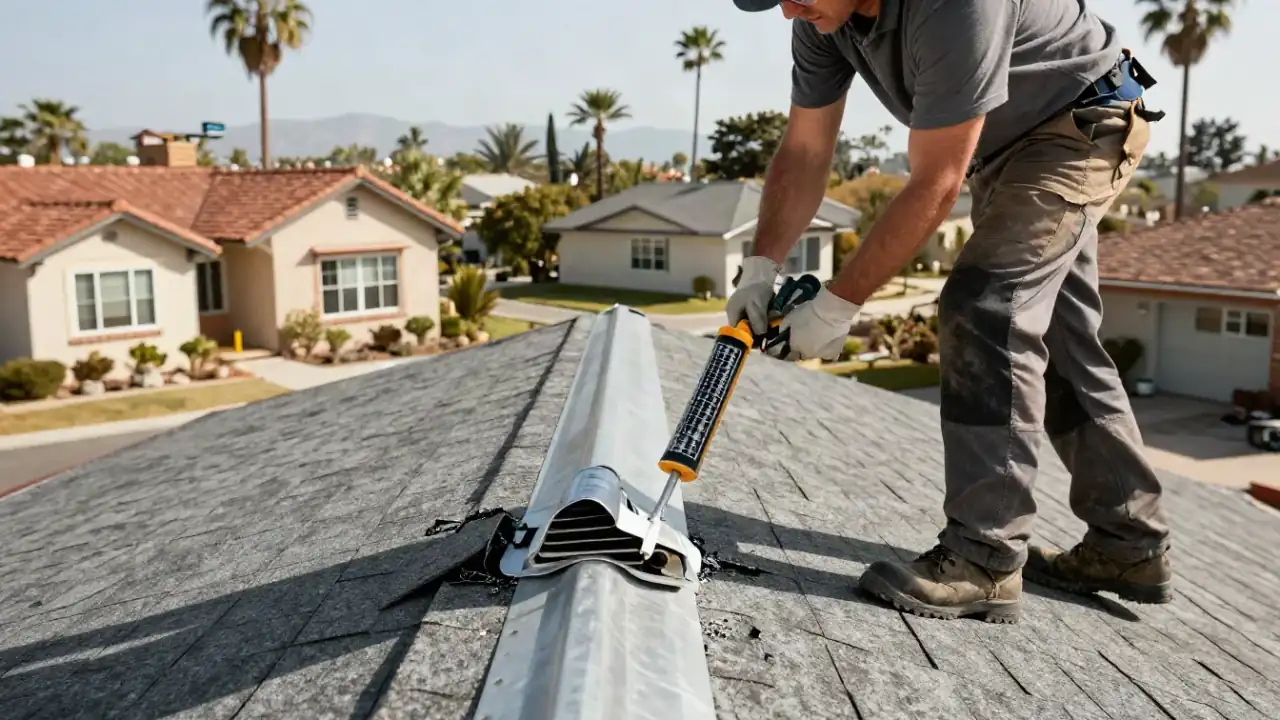
Tile roofs in Whittier leak most often because the underlayment beneath the tiles has aged out, not because the tiles themselves are broken. Tiles are a rain screen - the waterproof layer is the felt or synthetic membrane underneath, and once that membrane dries out and tears, water finds a path into your attic. The rest of this post walks through the specific causes we see on Whittier tile roofs, how to spot each one, and what it takes to fix them.
Why Tile Roofs Leak in Whittier, California
Tile roof leaks causes Whittier CA homeowners deal with are shaped by our local climate: hot, dry summers that bake underlayment, followed by winter rain that finally finds every crack. Clay and concrete tiles are rated to last 50 years or more, but the underlayment under them typically fails between 20 and 30 years. That mismatch is the single biggest reason a Whittier tile roof starts dripping long before the tiles look worn out.
Whittier also sits in a zone where afternoon sun pushes attic temperatures past 140°F in July and August. That heat cycles the underlayment, the flashing sealants, and the pipe boot rubber every single day. By the time the first real storm of the season hits in November or December, materials that looked fine in spring are cracked and brittle.
If you want a baseline on what a proper inspection covers, our Roof Leak Repair Whittier CA page outlines how we trace a leak from the ceiling stain back to the actual entry point.
Cracked and Broken Tiles Let Water Straight Through
Cracked tiles are the most visible cause of tile roof leaks, and they usually come from three sources: foot traffic, thermal shock, and wind-driven debris. A hairline crack in a field tile lets water through immediately, and it also exposes the underlayment below to UV that accelerates its failure.
We see this constantly on two-story Whittier homes where someone walked the roof to clean a chimney or adjust a satellite dish. Clay tile cracks under a 180-pound step. Concrete tile is more forgiving but still chips at the corners, and once a corner is gone, the interlock that sheds water sideways is gone with it.
Thermal shock is the second culprit. On a 95°F afternoon, a sudden cold hose-down or an evening marine layer can crack a tile that was already stressed. If you find three or more cracked tiles in one area, that's usually a sign of a bigger problem underneath - not just cosmetic damage.
Failed Underlayment Is the Real Leak Source
Failed underlayment is the number one cause of tile roof leaks on homes built in Whittier between 1975 and 2000. The tiles on those roofs are often still in good shape, but the 30-pound felt underneath has dried, wrinkled, and torn at the fasteners.
Here's what happens: the felt is nailed to the deck, and every nail head is a tiny puncture point. Over 25 years of heat cycling, the felt shrinks around those nails and tears. Water that gets past a cracked tile - or even just past a lifted tile during a wind-driven storm - runs along the felt until it finds a tear, then drips onto the drywall below.
You can't see failed underlayment from the ground. The only reliable way to check is to lift a few tiles in the field and look at the felt condition. If it crumbles when you touch it, the whole roof is due for a tile lift-and-relay with new underlayment. That's a bigger job than a patch, but it's the only fix that actually stops the leak long term.
Flashing Failures at Walls, Valleys, and Chimneys
Flashing failures account for roughly a third of the tile roof leaks we repair in Whittier, and they're the hardest to diagnose from inside the house. Flashing is the metal - usually galvanized steel or copper - that seals the joints where your roof meets a wall, a valley, a chimney, or a vent.
On tile roofs, the flashing is often hidden under the tile courses, which means a small failure can channel water several feet sideways before it shows up as a ceiling stain. That's why the stain is rarely directly under the leak.
Wall and Step Flashing
Step flashing at a sidewall takes the most abuse. The sealant bead along the top edge dries out every 5 to 7 years in our climate, and once it cracks, water wicks behind the flashing and into the wall cavity. We re-seal and, when needed, replace the step flashing entirely - a job that typically runs $400 to $900 depending on the wall length.
Valleys
Roof valleys collect water from two planes, so any debris or failed metal there causes a leak fast. Whittier's sycamores and pepper trees drop leaves that pile up in valleys and hold moisture against the metal. If your valley flashing is rusted through or the tiles aren't properly cut back, water backs up under the tile edges. Our Valley Leak Repair Whittier CA service handles exactly this - clearing the valley, replacing the metal, and re-laying the tiles to shed correctly.
Chimneys
Chimney flashing on tile roofs is a common failure point because the counter-flashing is often just surface-sealed rather than properly embedded in the masonry. When that sealant fails, water runs down the chimney chase and shows up as a stain on the ceiling near the fireplace. We see this most often on older homes in Uptown Whittier, where 1920s and 1930s masonry chimneys are still in service.
Pipe Boots, Vents, and Skylights
Pipe boots and vent penetrations are the most common single-point leak on any roof, tile or otherwise. The rubber collar around a plumbing vent pipe cracks after 10 to 15 years of UV exposure, and once it splits, water runs straight down the pipe into the attic.
On a tile roof, the boot is usually tucked under a tile course, so you won't see the crack from the ground. A $15 rubber boot is the part; the repair runs $250 to $450 because the tiles around it have to come up and go back down correctly.
Skylights are a similar story. The seal between the skylight frame and the tile fails, or the curb flashing rusts. If your skylight leaks only during wind-driven rain, the issue is almost always the flashing on the upslope side. We handle those with our Skylight Leak Repair Whittier CA service, which includes re-flashing the curb and testing with a hose before we close it up.
What Causes Tile Roof Leaks Whittier CA Homeowners Miss
Some causes of tile roof leaks are obvious, and some hide in plain sight. These are the ones we find after homeowners have already paid someone else to "fix" the leak once:
- Clogged valleys and gutters. Water backs up under the tile edges and rots the fascia. Clean valleys twice a year - once in late October before the rains, once in April.
- Failed tile underlayment at the ridge. Ridge tiles are mortar-set, and that mortar cracks. Water gets under the ridge cap and runs down the felt.
- Debris dams behind chimneys. Leaves pile up on the upslope side of a chimney and hold water against the flashing for days after a storm.
- Nail pops through the underlayment. When the deck moves, nails back out and poke through the felt. Every one is a potential drip point.
- Condensation, not a leak. In Whittier's summer heat, attic condensation can mimic a leak. If the stain appears in August with no rain, it's probably humidity, not a roof failure.
One more thing homeowners miss: a leak that shows up in the middle of a room is often entering 10 to 15 feet away. Water follows the deck slope and the framing before it drips. That's why we trace leaks with moisture meters and, when needed, a hose test rather than guessing from the stain location.
What to Watch Out For
The biggest mistake we see is patching the symptom instead of the source. A tube of roof sealant smeared over a cracked tile will stop the drip for one season - maybe two - and then fail again, usually worse, because now the underlayment underneath has had extra time to rot.
Second mistake: letting a roofer walk the tile without soft-soled shoes or walk boards. Tile cracks under concentrated weight, and a careless inspection can create three new leaks while checking for one. Ask anyone you hire how they plan to access the roof.
Third: ignoring small ceiling stains. A stain the size of a dinner plate usually means 5 to 10 gallons of water have already entered the attic. By the time you see it, the insulation is wet, the framing is damp, and mold has a 24-to-48-hour head start.
If you're also dealing with a flat section - a patio cover, a garage, or an addition - those leaks behave differently and need a different repair approach. Our Flat Roof Repair Whittier CA service covers those separately from the tile work.
When to Call a Professional
Call a professional when the leak comes back after a repair, when the ceiling stain grows during a storm, or when you can't safely get on the roof to look. Tile roofs are slippery when wet, and walking them without the right footwear is how homeowners end up with a hospital bill on top of a roof bill.
We also recommend a professional inspection any time you're buying a Whittier home with a tile roof that's more than 20 years old. A 30-minute inspection with photos of the underlayment condition can save you a $12,000 to $18,000 full re-roof you didn't budget for - or give you the leverage to negotiate it into the sale price.
Whittier Roof Leak Repair handles tile roof leak repair across Whittier and the surrounding neighborhoods. We find the leak, fix the actual cause, and hose-test the repair before we leave. No guesswork, no repeat visits for the same drip.
Frequently Asked Questions
What causes tile roof leaks in Whittier CA?
Failed underlayment is the top cause, followed by cracked tiles, flashing failures at walls and valleys, and worn pipe boots. In Whittier, 20-to-30-year-old underlayment is the usual culprit even when the tiles themselves still look fine.
Why does my tile roof leak in Whittier California?
Our heat cycling - 140°F attics in summer, wet winters - dries out underlayment and sealants faster than in cooler climates. A tile roof that's 25 years old in Whittier has seen the equivalent of 35 years of wear in a milder region.
How are tile roof leaks repaired in Whittier?
We lift the tiles around the leak, replace the failed underlayment or flashing, then re-lay the tiles and hose-test the area. Most single-point repairs take 2 to 4 hours and run $350 to $900 depending on access and materials.
Who fixes tile roof leaks near me in Whittier CA?
Whittier Roof Leak Repair handles tile roof leak repair throughout Whittier, including Uptown, Friendly Hills, and East Whittier. Call (562) 443-3829 and we'll schedule an inspection, usually within 24 to 48 hours.
Can I just replace the cracked tiles and stop the leak?
Sometimes, but only if the underlayment below is still intact. If the felt is torn or brittle, new tiles over old underlayment will leak again within a season. We check the felt condition before recommending a tile-only repair.
Get Help with Roof Leak Repair in Whittier
If your tile roof is leaking and you want it fixed right the first time, call Whittier Roof Leak Repair at (562) 443-3829. We'll find the actual source, repair it, and test it before we leave - so the next storm doesn't put you back on the phone.